 |
|||
|
|
|||
| You are here: EDC Gateway > Spaceship Earth > Original Version ('82-86) | |||
|
Attraction: Extras: |
 This is the original version of the Spaceship Earth attraction which ran from October 1, 1982 until May 25, 1986. It was replaced with Walter Cronkite's narration and a new finale song on May 26, 1986. There is conflicting information about the identity of the original narrator. Names reported include Vic Perrin, Walker Edmiston, and Walter Pigeon. For now, until conclusive evidence is found, Vic Perrin will be used. When a paragraph of narration ends, that means that there is a pause
in the narration. A new paragraph beginning with "Vic Perrin:" means that the narration
is continuing. When you see this logo below, Passing directly beneath the remarkable structure, we proceed up a short ramp passing two posters, a sign, and a large mural before entering the pavilion. The two posters on either side of the entrance queue show a painting of Spaceship Earth with stars in the distance behind it. Both say "Ride the Time Machine from the Dawn of Civilization to the Beginning of Our Tomorrow. SPACESHIP EARTH." The sign which is along the right side of the ramp reads "Spaceship Earth is a slow moving attraction that explores the history of human communications. Since travelers will be transported to the furthest regions of our solar system, the attraction is not recommended for those who experience anxiety in dark, narrow or enclosed spaces." The mural depicts astronauts working on a satellite with Earth in the distance. Surrounding them are smaller images of cavemen, the Egyptians, the Romans, Gutenburg and his printing press, and modern day people. These announcements are heard as we near the entranceway:
Once in the small room, we board blue, constantly moving "time machine" vehicles. Another announcement continuously plays over speakers in the room.
The vehicle enters a dark tunnel and rises sharply upward. A starfield appears as Mr. Perrin begins his narration. As we near the top, we see a projection of purplish clouds and an occasional lightning bolt.
Once at the top of the tunnel, images of early human pioneers (men with spears or holding rocks) and mammoths are projected onto a large screen. Every few seconds the images ripple with a wave and then reappear.
Vic Perrin: Where are we now? It is the [unlinked] waiting dawn where vast things stir and breathe. And with our first words and first steps, we draw together to conquer the mammoth beast. It is the dawn of a new beginning, the dawn of recorded time. Vic Perrin: On cave walls we inscribe our greatest triumphs, a growing record of our deeds, to share with others so they too may greet tomorrow’s sun. Moving into an Egyptian temple (representing 1567 - 1085 B.C.), a man on the left is making paper out of papyrus. On the right, next to an elaborate entrance to a building (the archways are decorated with hieroglyphics), a man stands high upon scaffolding carving a ventilation hole near the top of a tower. Further ahead on the left, an Egyptian pharaoh is dictating a message as a scribe copies it onto the new paper. His wife is seated next to him while a servant fans them. Vic Perrin: Ages pass and more walls rise in the valley of the Nile. Man-made walls of hieroglyphics. Then with new symbols, we unlock our thoughts from chiseled walls and send them forth on papyrus scrolls. In the Phoenician scene (9th century B.C.), two ships meet in the ocean to exchange goods. Another man on the larger ship (behind the smaller ship) holds a rope that is connected to the smaller ship so that both ships stay together. Fog surrounds the ships. Smoke rises from small fires in pots at both ends of the larger ship. To the right of us is a wall showing the ocean going to the horizon and stars above. Vic Perrin: On fine Phoenician ships, we take our scrolls to sea. Real scrolls simplified by an alphabet, eagerly shared at distant ports of call. Up next on the right, is the Greek Theatre. Two men wearing masks are performing "Oedipus Rex" written by Sophocles circa 428 B.C. Another man holding his mask is standing towards the back of the scene probably waiting for his part to come up. Vic Perrin: Deep in the shadows of Mount Olympus, our alphabet takes route ... flowering with new expression. Hail the proud Greeks: Aeschylus, Sophocles, Euripides. The theater is born. Ahead on the left, a young Roman man holds the reins to a two horse-drawn chariot. The man (dressed as if he is in the Roman army) who arrived in the chariot is now exchanging information with another man (dressed in a toga). The man holding the reins is standing on the ground with the horses, the army man is standing one step up, and the man in the toga is standing one step up from there on a marble platform. He is between four large columns, two on each side. Smoke rises from two small fires in metal pots/stands on both ends of the scene. In the back is a painted wall showing the streets of Rome. An animated horse-drawn cart with a man riding in it dashes out of one street and off into the distance. Vic Perrin: North, South, East, and West, all roads lead from Rome, a mighty network reaching across the land, welding far-flung garrisons into a growing empire. We then see a building in ruins with smoke rising from it. The smell of the burning building fills the air. Vic Perrin: Glorious Rome, until consumed by the flames of excess. Imperial Rome, lost in the ashes of darkness. Vic Perrin: Far from the dieing embers, Islamic wise men preserve ancient wisdom and weave a rich network of new knowledge linking East and West. In the Islamic Empire scene, on the right, four men sit around a table on pillows on the floor discussing topics. One man has two books right next to him and another has a wooden book holder that holds the book open to a specific page. On the left is a library with some books on the shelves (they aren't stacked full). Two men (one standing, one seated on pillows on an elevated platform) are reading. Standing up high on the balcony on the right is an astronomer looking at the stars through a quadrant (which is an exact replica of the real thing). Further ahead on the left, two Benedictine Monks (11th and 12th-century) are seated at their desks copying text. The one on the right has fallen asleep at the job. His chest rises and falls as he breathes in and out. Vic Perrin: In Western abbeys, Monks toil endlessly transcribing ancient wisdom into hand-penned books of revelation. Vic Perrin: At last! A new dawn emerges. The dawn of the Renaissance ... and a wondrous machine performs as a thousand scribes. Now for all: the printed word. On the left, two men are working with a large wooden printing press. Johann Gutenberg is studying a piece of paper that just came off the press (1456). In Renaissance Italy (1500s), on the right, one man is reading a book to two listeners on the steps. Also, two musicians are playing just beyond in front of a closed doorway. An Italian town can be seen through the columns and arches in the background. On the left, in an artist's studio, we see a man mixing paint, another painting some fruits (with a bowl of fruit as a guide), and another chiselling marble to create a statue. Sketches of the female subject are on the wall behind him and to the left of him is a small statue that he also uses as a guide. Further ahead and up on the left, we see Michelangelo painting the Sistine ceiling while lying on his back high upon scaffolding. Below, the stained glass church windows are illuminated with black light. To the right, is a conveyance system that allows buckets of paint to be hoisted up the scaffolding to Michelangelo.
Vic Perrin: The Renaissance: a beacon through the mists of time, guiding us to a new era. A time of invention and exploding communication. Now we move into the Age of Invention (19th and 20th centuries).
First we see a large steam powered printing press (by William Bullock
in 1863). Just like Gutenberg inspected his printed paper, a man stands
in front of the press and inspects a newspaper that was just printed.
Nearby, on a street corner, a boy stands with a stack of New York
Daily papers calling out
On the right, one man is dictating a message and the other is using a telegraph to send the message. Through the window and door behind them, we can see train tracks crossing the plains to the mountains in the distance. On the left, is a switchboard that three women (two seated, one standing) are operating. Behind that are several windows that represent homes and apartments throughout the town. Fiber optic telephone lines stretch from the switchboard across poles to the homes. We can hear conversations coming from the shadows of people in some of the windows. On the right, is a woman in a ticket booth. Above that and also spanning above us is a lighted "Cinema" sign. Three screens to the left of the booth show scenes from an old black and white movie about a guy on a runaway trolley ("Stop that trolley!" is one of the captions), another black and white movie showing two people dancing, and 20,000 Leagues Under the Sea (1954). Back on the left is the WDP radio station (WDP is, of course, short for Walt Disney Productions). A man and a woman inside the sound booth are live on the air acting out a story. A man outside the booth is checking sound levels and directing. To the right of that is a radio tower with a red light blinking on top. On the wall behind it is a painting of another radio tower in the distance. Surrounding its red light are drawings of the radio waves spreading from the tower. Just beyond that is a family (mother, father, and daughter) sitting in their living room around the TV. The mother changes the channel using a large (by today's standards) remote control. Four other TVs hang on the wall up behind the family TV. The TVs switch between Ozzie and Harriet, the 1964 NFL Colts vs. Browns Championship Game, Ed Sullivan and the Harlem Globetrotters, Walter Cronkite reporting, and Walt Disney introducing an episode of Wonderful World of Color. Vic Perrin: With each day come more paths, more ideas, more dreams, and we build new machines: computer machines that think, that store, sift, sort, and count, and help us chart our course through an age of boundless information. On the left is a small 70s bedroom. A young man is sitting at his desk working on a desktop computer. Plain metal shelves stand against the far wall holding a few books and model airplanes. The next scene shows a more modern (mid-80s) office in which a woman is using at a computer at her desk while talking on the phone. Vic Perrin: With these machines comes a wondrous new network of communications, a vibrant maze of billions of electronic pathways stretching to the very edge of space.
We then enter a tunnel in which lines of light whiz by overhead and on both sides. Vic Perrin: Verged on the threshold of infinity, we see our world as it truly is: small, silent, fragile, alive, a drifting island in the midnight sky. It is our spaceship, our Spaceship Earth. At this point, we are at the top of the geosphere looking at planet Earth in the distance. In the distance, we see Earth and all the stars of the universe surrounding it.
Vic Perrin: Our journey has been long. From primal caves we have ventured forth traveling the endless corridors of time seeking answers to our tomorrow. With growing knowledge and growing communication, we have changed our lives ... changed our worlds. Vic Perrin: From the reaches of space to the depths of the sea, we have spun a vast electronic network linking ourselves as fellow passengers together, on Spaceship Earth. To the right are several flat screens that have clouds of purple, blue, and red colors spiraling across them. The clouds look similar to the one at the beginning of the ride near the top of the tunnel. At the end of the first descent, on the right are more oddly shaped blocks of flat screens that are scattered across the space. Each one has a different video playing showing the outlines of children holding hands and of a person using a microscope, DNA chains, the universe, etc. Each block is connected with fiber optic strands that light up showing the transfer of ideas. We hear the sounds of people talking and exchanging information. Vic Perrin: Today our search for understanding is unbounded by space and time. Vast stores of information, knowledge from everywhere, standing ready at our beck and call to reach us in an instant. With our great network, we harness our knowledge, give it shape and form to serve us, to help create and communicate a better awareness of ourselves, and our world. Descending further, the walls are filled with dots of light moving through lines crisscrossing each other resembling a circuit. Then both walls are covered by mirrors and the dots of light are equally spaced out looking like a peg board. Vic Perrin: Ours is the age of knowledge ... the age of choice and opportunity.

Special Thanks to Todd Becker for the picture of Earth Station above and to Nicholas LeBlanc for providing the script. Spaceship Earth Introduction | Spaceship
Earth Script - Original ('82-86) | SE Script
- Cronkite | "Tomorrow's Child" Lyrics
Return to: EDC Gateway
Created December 15, 2001 / Last modified December 19, 2001 DISCLAIMER: Use of the EDC site signifies your agreement to the terms of use detailed in the Complete Disclaimer. This is a fan based site and is to be a source of entertainment and information. This site is NOT affiliated with or endorsed by the Epcot theme park and The Walt Disney Company. All photos presented within this site are © Copyrighted by EDC unless otherwise noted. |
||

 , click on it to listen to a .wav
of that paragraph or section.
, click on it to listen to a .wav
of that paragraph or section. We then
enter a cave and see a Shaman (medicine man) with a fur cape and antlers
on his head. Two men sit around the fire listening to the Shaman.
His large shadow is reflected by the fire onto the cave wall. A woman
is also listening while working with a fur. On the far right wall,
a man and a woman are painting a message on the wall. The drawings
are similar to those found in the Salon-Niaux cave in Ariège,
France (circa 10,000 B.C.). Sounds of animals growling echo through
the caves.
We then
enter a cave and see a Shaman (medicine man) with a fur cape and antlers
on his head. Two men sit around the fire listening to the Shaman.
His large shadow is reflected by the fire onto the cave wall. A woman
is also listening while working with a fur. On the far right wall,
a man and a woman are painting a message on the wall. The drawings
are similar to those found in the Salon-Niaux cave in Ariège,
France (circa 10,000 B.C.). Sounds of animals growling echo through
the caves. 

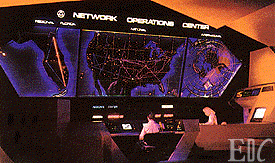 The
Network Operations Center that monitors network lines and satellites
is seen just ahead on the left. Three large maps are displayed and
show how the system is operating at that moment. From the left is
the state of Florida, the United States, and a view of the world looking
down on the North Pole. A man is sitting below the maps monitoring
the system. A woman is seated at another desk to the right of the
man.
The
Network Operations Center that monitors network lines and satellites
is seen just ahead on the left. Three large maps are displayed and
show how the system is operating at that moment. From the left is
the state of Florida, the United States, and a view of the world looking
down on the North Pole. A man is sitting below the maps monitoring
the system. A woman is seated at another desk to the right of the
man. Upon exiting the vehicle, we proceed to Earth
Station, EPCOT's original Guest Relations. There, we make
lunch or dinner reservations by talking to a human Cast Member via
video monitors on the WorldKey Information Service. The Cast Member
is able to hear and see us and is able to make reservations or answer
questions. When the terminals are not being used for reservations,
guests can get information on the different pavilions and where the
shops, restaurants, and restrooms are located. (These terminals were
moved just outside the new Guest Relations in Innoventions East in
1994 and were closed for good during the summer of 1999.)
Upon exiting the vehicle, we proceed to Earth
Station, EPCOT's original Guest Relations. There, we make
lunch or dinner reservations by talking to a human Cast Member via
video monitors on the WorldKey Information Service. The Cast Member
is able to hear and see us and is able to make reservations or answer
questions. When the terminals are not being used for reservations,
guests can get information on the different pavilions and where the
shops, restaurants, and restrooms are located. (These terminals were
moved just outside the new Guest Relations in Innoventions East in
1994 and were closed for good during the summer of 1999.) Overhead,
screens provide an overview of the EPCOT pavilions. Here, in this
picture, World of Motion is featured. Hosts and Hostesses
at the information desk provide general information. AT&T's Employee
Lounge is located on the second level of the building with a great
view of the fountain, CommuniCore, and World Showcase Lagoon.
Overhead,
screens provide an overview of the EPCOT pavilions. Here, in this
picture, World of Motion is featured. Hosts and Hostesses
at the information desk provide general information. AT&T's Employee
Lounge is located on the second level of the building with a great
view of the fountain, CommuniCore, and World Showcase Lagoon.