| |
2000

Epcot
2000
2000 Monorail Spiel
Millennium
Village
Tapestry of Nations
New Year's Eve
1999 & 2000
IllumiNations 2000: Reflections
of Earth
Other Epcot 2000
Highlights
Millennium Celebration Construction
EDC Site Map
Search
Contact
INTERCOT
|
|
|

The information on this site may not be reproduced in
any form including on the Internet without express permission
from the EDC.
Eritrea
Presented by The State
of Eritrea, Ministry of Tourism
The information
on this site may not be reproduced in any form on the
Internet without express written permission from EDC.
Beyond Sweden is the exit to the World
ShowPlace. The Millennium Village Gifts to the World
logo is projected in white light above those doors.
Beyond the doors are what appear to be a strange number
of lighted signs that we can walk amongst. When standing
back away from the signs (actually by another sign
that is smaller and in front of the Africa counter
at The Gift of Cuisine), we can read the name of the
country by looking at the panorama of the signs together:
Eritrea.
The little sign shows its location in
Africa south of Egypt and SUDAN. It says the country
is the youngest in Africa but yet has a history 3,000
years old. Eritrea, formerly part of Ethiopia, is
made up of nine tribes that live together as one fighting
for independence. The large signs not only have the
large letters of the country's name, but the top of
each sign, when put together, forms the topography
of the country - from the mountains on the left side
to the ocean on the right side. Each of the nine signs
has images and words that show (from left to right)
the Gifts of: Diversity, Hospitality, Creativity,
Harmony, Hope/Dreams, Nature, Heritage, Abundance,
and Family.
In the back left-hand corner of the
exhibit is a table set low to the ground with soft
cushioned benches. A sign on the wall identifies this
area as an Eritrean Coffee Ceremony. Sitting down,
we are served traditional Eritrean coffee and can
talk with a native of this country.
Folk Art
Across from Eritrea are nine interpretations
of the Coke bottle. Artists from over 65 countries
created their own designs to form the contour of the
Coca-Cola bottle. Nine of the creations are displayed
here.
The Gift of Cuisine
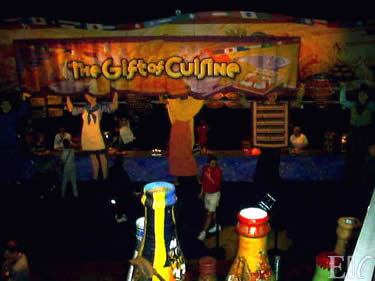
Across from the Coke bottles is a food
court area called The Gift of Cuisine. From
left to right are counters for the following regions:
Europe, Asia, Pacific Rim, Middle East, Africa, North
America, Caribbean, South and Central America. Also
next to and with the South America counter at the
far end is a counter where the wines of Chile can
be sampled. Giant painted flat images of people dressed
to represent these regions are spaced between each
region's counter. They each have their hands holding
trays of the region's food being offered. Signs between
the trays identify the region and list the food available
and price. We are free to go up to any counter, order
an item, and then go to another region to get something
else. When we have everything we want, two to four
cashiers sit at the far end of the area. Behind them
is a large seating area. The walls at the back perimeter
of the area are covered with drawings of fruit, vegetables,
bread, and other foods.
Gifts from the
World
This open merchandise area features
products and gifts that have been showcased, highlighted,
mentioned in, or associated with the exhibits in Millennium
Village. Here we find flags and shirts representing
the countries in the Village, Brazilian soccer shirts,
pants, and jackets, Tivoli Gardens items, jewelry,
Millennium Village pop-up maps, envelopes stamped
from Israel, postcards (including several of a yurt),
wind up radios that use no batteries, Millennium Celebration
books and videos, and Tapestry of Nations toy puppets.
The back section was changed in the late summer of
2000 to showcase crafts from Ecuador. An artisan creates
Panama hats right in front of us and another cast
member shows us how they can be folded up and stored
in a light-weight wooden box.
Journey to Jerusalem
Presented by Ministry of Foreign Affairs,
State of Israel
Beyond the Gift of Cuisine and Gifts
from the World is Journey to Jerusalem. A sign
by the entrance warns that a mild simulator ride lies
within and a video shows what some parts of the movie
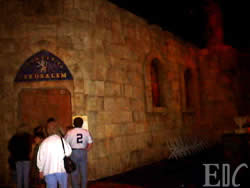
are about. Entering through the archway beneath the
shining illuminated sign, we walk through a colorfully
lit stone hallway with stone arches, tile floor, and
four light colored stained glass windows (two on each
side). The sound of church bells ringing, wind chimes,
and holy music is heard. This is a recreation of an
avenue found in Jerusalem and is paved with real stone
from the city. This leads into a holding area for
the show. A giant panoramic picture of the city of
Jerusalem covers the wall on the left. Three interactive
video terminals sit along the half-wall to the right.
Beyond the wall, we can see diners eating the various
cuisines from around the world. Ahead of us is another
stone wall with large wooden doors closed.
 Sometimes,
a cast member from Israel tells us about the large
picture of the city and facts about its history. When
the show is ready, cast members open the doors and
instruct us to enter the pre-show room. If a guest
does not want to ride in the simulator, he or she
can choose to sit in the stationary seats and thus
must keep to the left side of the room. The dark,
plain room has three paintings on the right wall and
a screen at the front. The Journey to Jerusalem logo
appears on the screen. Here we will watch the pre-show
as our guide takes us on a fast-paced tour of the
city. When she asks us to reboard the bus for the
rest of our tour, an older man appears amongst bright
light. He says he is David, keeper of the stories,
and tells our tour guide there is so much more of
Jerusalem's history to explore. She agrees to let
us hear what he has to share with us. Sometimes,
a cast member from Israel tells us about the large
picture of the city and facts about its history. When
the show is ready, cast members open the doors and
instruct us to enter the pre-show room. If a guest
does not want to ride in the simulator, he or she
can choose to sit in the stationary seats and thus
must keep to the left side of the room. The dark,
plain room has three paintings on the right wall and
a screen at the front. The Journey to Jerusalem logo
appears on the screen. Here we will watch the pre-show
as our guide takes us on a fast-paced tour of the
city. When she asks us to reboard the bus for the
rest of our tour, an older man appears amongst bright
light. He says he is David, keeper of the stories,
and tells our tour guide there is so much more of
Jerusalem's history to explore. She agrees to let
us hear what he has to share with us.
We then enter the main theater. The
simulators are arranged in three rows, with two and
stationary seating in the front row, three in the
middle row, and three simulators in the third row.
The fourth row is additional stationary seating. Three
screens are in the front of the room with the outer
two slightly angled in. The lap bars and the stairs
we used to climb into the simulators are lowered.
David takes us through several stories
out of Jerusalem's past including how the city's structures
and architecture have changed. The simulators follow
the moves the images on the movie make allowing us
to feel like we are flying over and through the city
or viewing a story from above. Upon the conclusion
of the movie, we exit through the doors on the left
and down a hallway into the Inspired by Israel
exhibit.
The exhibit features the following displays:
-
Abundant Energy
- solar and geothermal energy
-
Images of Israel -
by looking through small windows in the Western
Wall, guests can see constantly changing images
of the country
-
Electronic Pilgrimage
- computers allow guests to type prayers which
will be printed and delivered to the real Western
Wall in Jerusalem
-
Garden of Plenty
- irrigation and desert farming
-
Gift of Language
- guests can get their name translated and written
in Hebrew
Continue on the path or choose
an exhibit from the list below:
Return to: Epcot
2000 | EDC Gateway
| INTERCOT
 If you have any questions,
comments, or corrections, please contact the EDC Webmaster. If you have any questions,
comments, or corrections, please contact the EDC Webmaster.
© EPCOT Discovery Center
Created January 1, 2001 / Last modified
November 18, 2001
DISCLAIMER:
Use of the EDC site signifies your agreement to the
terms of use detailed in the Complete
Disclaimer. This is a fan
based site and is to be a source of entertainment
and information. This site is NOT affiliated with
or endorsed by the Epcot theme park and The Walt Disney
Company. All photos presented within this site are
© Copyrighted by EDC unless otherwise noted.
|
|