|
|||||
|
|
|||||
| You are here: EDC Gateway > Horizons > Script Part 1 | |||||
|
Attraction: Extras: |
The information on this site may not be reproduced in any form on the Internet without express written permission from EDC. Approaching the pavilion from other parts of Future World, we see what looks like a huge spaceship that has just landed. Nearing the entrance, we can hear instrumental versions of "New Horizons" and even a little "We Bring Good Things to Life." Once inside the pavilion, by using the automatic sliding doors on the left, we see the quote "If we can dream it, we can do it." The song "New Horizons" is playing in the background. Turning right, we see a large lighted sign that shows all of the flights scheduled for departure from the FuturePort. Our flight, "Flight 83 - Horizons," is flashing since it is now boarding. (Of course, the significance of the Flight number is that Horizons opened in 1983, thus Flight number 83.) Below is a drawing replicating the sign. The actual sign doesn't look exactly like this, but it is close. To get a clearer, closer look, just click on the picture. To the right of the sign are closed doors marked "Concourse B" (the doors are fake and don't open). We proceed through the open doorway marked "Concourse A" to the left of the sign and then down the ramp. An instrumental version of "New Horizons" fills the room. Three travel posters, each one surrounded by mirrors, show scenes of a floating habitat, a futuristic desert city, and a space colony. A kaleidoscope effect is created by the way the mirrors surround each painting and the way each painting moves back and forth or up and down. Also, a globe-like circular effect is created when looking in the mirrors. The first one is of a floating city in the ocean. This announcement is heard:
The next poster shows the expansive desert city, Mesa Verde.
The final poster shows a shuttle docking at a space colony.
Next, we approach the moving platform that will take us to our ride vehicle.
Cast Members point out which vehicle is for us and remind us to watch our step. Once we have boarded the unique, suspended four passenger vehicle, we hear this announcement:
NOTE: Since the pavilion opened in 1983, a few lines of dialog have been changed or modified. Instead of what the man originally said (until late 1984/early 85?), a woman now says:
Not much of a change, but still worth noting. Moving on, the doors have closed and the vehicle turns to the right where we see a wall of one dimensional clouds before us. Colored lights and "lightning flashes" behind the clouds flash on and off indicating that we are traveling back in time. Another change in dialog was made to the introduction. A female announcer originally said:
That was changed to:
Entering the "Looking Back at Tomorrow" segment of the attraction, we see pictures of man's earlier attempts at flight/space travel which appear and disappear with waves of colored light. All of them don't appear to be very safe. The first one, has a person suspended from a flock of birds flying through the air. That changes to a man suspended from an umbrella with a balloon on top. The set in the upper right corner has a sign that says "First Moon Flight." A crowd of onlookers watches as the cannon is ignited and a space ship blasts towards the moon in the background. This concept is, of course, from Jules Verne's novel, From the Earth to the Moon. That picture changes to a closer look at the space ship careening towards the moon. The final set of pictures shows a person flying with bird-like wings attached. That changes to an aerodynamic ship with several umbrellas serving as the roof.
A spaceship as envisioned by Jules Verne is seen with Jules, a barking dog, and a clucking chicken floating weightless inside. The plain metallic exterior is in sharp contrast to the very elegant interior (notice the light fixtures and the velvet cushions).
Next, is the moon with a projected image of the "man in the moon" on its surface. Verne's spaceship is sticking out of the smiling face's right eye. The left eye looks around and then at the ship. Black lit stars fill the background behind the moon. Some of the stars also have smiling faces on them.
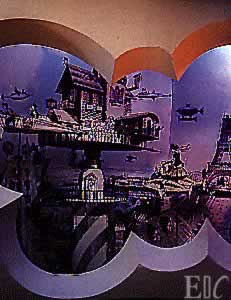
The next scene is based on the work of the nineteenth century French futurist Albert Robida. It portrays his vision of Paris in 1950 with subways, flying fish (which move up and down), dirigible taxis, an express trip to Madrid, and high rise buildings that have a small 1800s country village look. The sets are all flat, two dimensional, and black and white with a little red, white, and blue lighting representing the French flag colors.
And just around the corner is a typical 1920s or 30s sci-fi home of the future complete with robots that clean and cook. One man holds a cigarette while looking at the vast city lights outside. Another is reclining while a robot is giving him a haircut, manicure, tan, and a shoeshine all at once. The Tan-O-Matic allows him to choose which level of tan he wants: "Hawaiian," "Caribbean," "Miami Beach," or "Palm Springs." The Atmospheric Storage Co.'s product allows him to have either "Tropical Breezes" or an "Alpine Chill" blown on him. On the second level, a woman is taking a bubble bath while a man on the TV is singing "There's A Great Big Beautiful Tomorrow" from G.E.'s first Disney attraction, the Carousel of Progress. In the kitchen, a robot's head is spinning uncontrollably at the mess its five arms have to clean up. While two hands are washing dishes, another hand is sweeping the floor, another is cooking on the stove, and yet another is spilling milk on the floor much to the cat's liking.
This scene features three screens that show clips from old movies and a Disney cartoon. The first screen plays Metropolis (Fritz Lang, 1926), Modern Times (Charlie Chaplin, 1936), and Woman in the Moon (Fritz Lang, 1928). The second screen plays Just Imagine (David Butler, 1930), Things to Come (William C. Menzies, 1936), and Buck Rogers (Ford beebe & Saul A. Goodkind, 1940). Behind the first two screens, black lit movie theater signs dot the landscape. Those signs say "Nickelodeon," "The Time Machine," "Things to Come," "Metropolis," "Bijou," "Strand," "Le Voyage Dan la Lune," "Admit One," "Now Playing," and "Looking Back at Tomorrow." The third screen is shaped liked a TV set with black lit TV antennas and the "Mars and Beyond" sign behind it. A segment from Magic Highways goes like this:
Turning the corner, we encounter a neon-like black lit futuristic 50s scene with cars and buildings similar to "The Jetsons." Loud 50s music accompanied by beeping cars and helicopters is heard. This scene shows the future as those in the 1950s envisioned it. Rockets on the left are available for rent; the Skyline Express (a suspended monorail) shuttles people between New York, Chicago, and Los Angeles; the Astro Burger restaurant has a sign out front that says "Fly in UFO's Welcome;" and a person with his/her dog (both wearing rocket packs) flies in from above. "Cosmic College" and "Galaxy High School" are in the middle background and signs to "Orbit Town" and "Starfield Stadium" are on the right. "Galaxy Towers - The Stars Homes" is located above the 200 mph speed limit highway, but unfortunately the highway is "CLOSED - Out to Launch" which explains all of the beeping. The futuristic cars are forced to turn around and head back. Way up in the left-hand corner, is a familiar sight to Disneyland guests between 1957 and 67 - a building reminiscent of the Monsanto House of the Future.
As we move out of that scene, a wall with red and pink lights at
the top blink on and off. The original effect here also utilized 40
miles of fiber optics and 22,000 points of light for both this wall
and the one after the OmniSphere. That's why there are all of those
tiny holes in the wall. The shifting colors of light serve as an effective
way to convey that we are moving on, or traveling through time, from
the "futuristic" 50s to the present (80s). (Unfortunately,
many years ago the fiber optic part of the effect was discontinued,
probably because of a malfunction, and has not worked since.)
Continue on into the OmniSphere theater. Horizons Script Page 1
| Script Page 2 | Script
Page 3 | Script Page 4 Return to: Horizons Introduction | EDC Gateway  If you have any questions, comments, or corrections, please contact
the EDC Webmaster.
If you have any questions, comments, or corrections, please contact
the EDC Webmaster.
© EPCOT Discovery Center DISCLAIMER: Use of the EDC site signifies your agreement to the terms of use detailed in the Complete Disclaimer. This is a fan based site and is to be a source of entertainment and information. This site is NOT affiliated with or endorsed by the Epcot theme park and The Walt Disney Company. All photos presented within this site are © Copyrighted by EDC unless otherwise noted. |
||||